

Molecular and Translational Cardiology
Stem Cell-derived products to treat heart disease. We demonstrated that the beneficial effects exerted by mesenchymal stromal cells (MSC) on ischemic hearts are mediated by their secretome, and that MSC of fetal origin (F-MSC), isolated from the amniotic membrane of human placenta are more effective than adult MSC isolated from the bone marrow. Accordingly, we are developing clinical-grade protocols for scaling up the production of F-MSC and their secretome. The ambitious goal is to implement therapies based on the use of whole secretome or microvesicles or single factors produced by F-MSC to treat acute myocardial infarction (AMI), heart failure (HF), and pulmonary arterial hypertension (PAH).
Precision Cardiology. Starting from somatic cells isolated from patients, we generate induced pluripotent stem cells (iPSCs) and then differentiate them into cardiomyocytes (CM) in just a few weeks. We have proved that patient-specific iPSC-CMs recapitulate the cardiac phenotype of hereditary cardiac arrhythmias and can be used to test antiarrhythmic drugs. iPSC-CMs faithfully summarize ‘patient on a plate’ (individual level) and ‘clinical trial on a plate’ (population level) conditions. Thus, we are exploiting this technology for the implementation of Precision Cardiology approaches for treatment and prevention that give us the possibility to consider individual genetic and phenotypic variability, allowing the identification of targeted diagnostic and therapeutic strategies.
Acute myocardial infarction registry. More than 15 years ago we started an observation study including all patients admitted to our Cardiology Division with a diagnosis of acute ST-elevation myocardial infarction (STEMI). The database is still regularly updated with follow-up of the patients. Several outcome studies have been published based on this registry’s data, and more will be performed to document how the treatment and the outcome post-STEMI evolves over time.
PREDESTINATION study. It is a case-control, prospective, multicenter study of which our Unit is the lead partner. The study aims to identify the genetic and clinical causes underlying primary ventricular fibrillation events throughout the onset of an acute myocardial infarction (STEMI). Over 1500 patients have already been enrolled.
- Gnecchi M., Sala L., Schwartz P.J. Precision Medicine and cardiac channelopathies: when dreams meet reality. European Heart Journal, 2021;
- Lee Y.K., Sala L., Mura M., Rocchetti M., Pedrazzini M., Ran X., Mak T.S.H., Crotti L., Sham P.C., Torre E., Zaza A., Schwartz P.J., Tse H.F., Gnecchi M. MTMR4 SNVs modulate ion channel degradation and clinical severity in congenital long QT syndrome: insights in the mechanism of action of protective modifier genes. Cardiovascular Research, 2021;
- Mehta A., Ramachandra C.J.A., Singh P., Chitre A., Lua C.H., Mura M., Crotti L., Wong P., Schwartz P.J., Gnecchi M., Shim W. Identification of a targeted and testable antiarrhythmic therapy for long-QT syndrome type 2 using a patient-specific cellular model. European Heart Journal, 2018;
- Ciuffreda M.C., Malpasso G., Chokoza C., Bezuidenhout D., Goetsch K.P., Mura M., Pisano F., Davies N.H., Gnecchi M. Synthetic extracellular matrix mimic hydrogel improves efficacy of mesenchymal stromal cell therapy for ischemic cardiomyopathy. Acta Biomaterialia, 2018;
- Danieli P., Malpasso G., Ciuffreda M.C., Cervio E., Calvillo L., Copes F., Pisano F., Mura M., Kleijn L., de Boer R.A., Viarengo G., Rosti V., Spinillo A., Roccio M., Gnecchi M. Conditioned medium from human amniotic mesenchymal stromal cells limits infarct size and enhances angiogenesis. STEM CELLS Translational Medicine, 2015.
- Cell culture room equipped with two laminar hoods, three CO2 incubators, hypoxia incubator, centrifuges, light microscope, stereomicroscope.
- Equipment for cloning and molecular biology analyses, including nanodrop spectrophotometer, gradient and Real-Time thermocyclers, multimode imaging plate reader, Simple Western Jess, Odyssey infrared imaging system.
- Histology sample preparation (microtome and embedding station). Inverted fluorescent microscope and stereomicroscope with a wide array of filters.
Ricerca corrente projects n° 08064009, 08064017, 08064018 and 08064021. AIFA-TRS-2018-00001470. Fondazione Cariplo No. 2019-1691. Leducq Foundation for Cardiovascular Research [18CVD05]. Progetto PRIN 2022 – 2022RZCWWH.
- Fondazione Istituto Neurologico Mondino (Pavia),
- Istituto Auxologico Italiano IRCCS (Milan),
- Università di Milano-Bicocca, Università di Messina (Messina),
- ISMETT (Palermo),
- University of Cape Town (SA), Stanford University School of Medicine (USA),
- Center for iPS Cell Research and Application of Kyoto (Japan),
- Technion-Israel Institute of Technology (Israel),
- Vanderbilt Center for Arrhythmia Research and Therapeutics (USA).
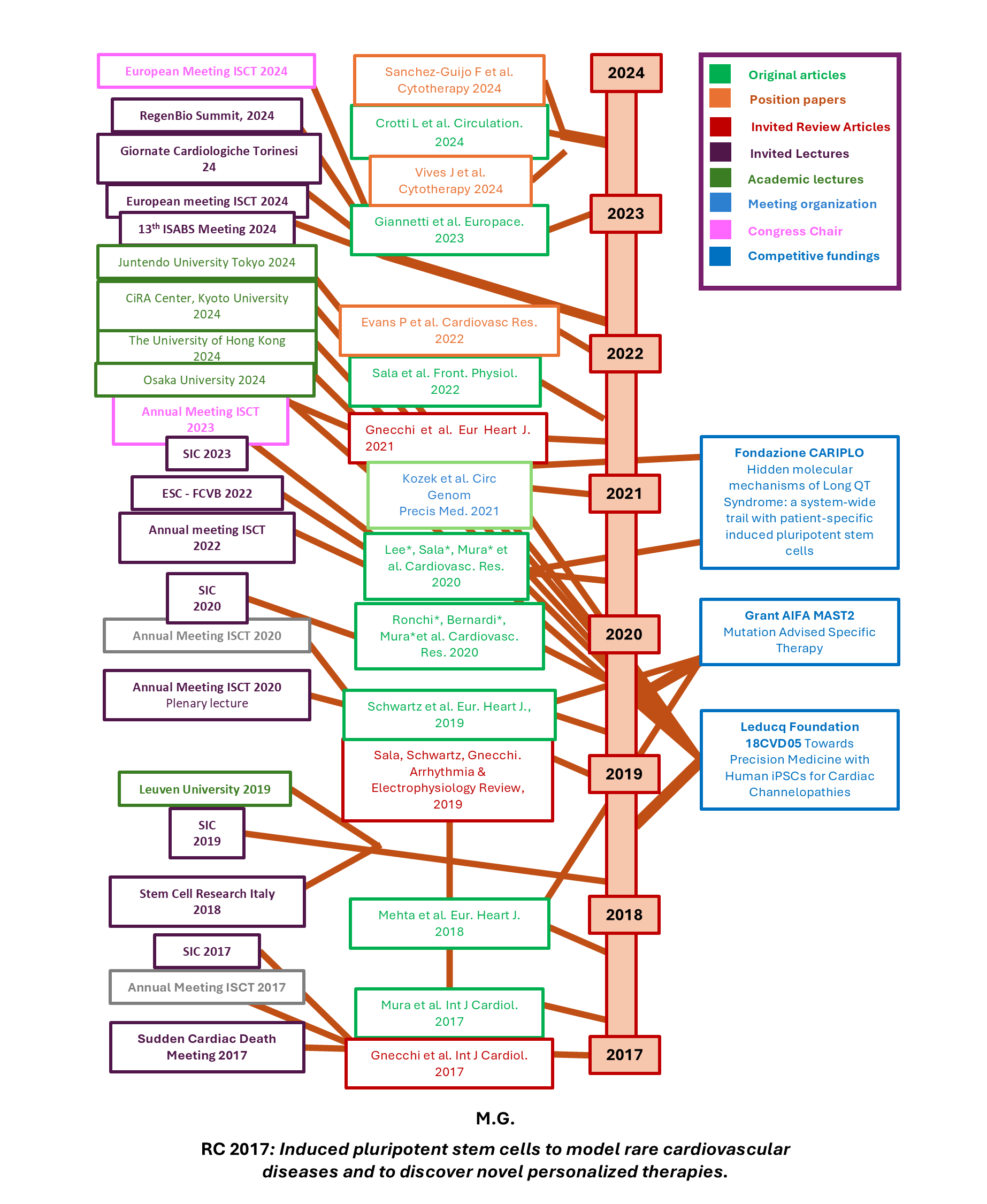
OTHER MEMBERS:
Aurora Dosio, Chiara Guarona, Miriam Giusi Lorusso, Carolina Paola Miguel, Sara Montanaro, Manuela Mura, Antonio Sanzo.
Dott.ssa Camporotondo Rita
Dott.ssa Guida Stefania
Dott.ssa Petracci Barbara
Dott. Rordorf Roberto
Dott.ssa Totaro Rossana
Dott. Vicentini Alessandro
Ultimo aggiornamento: 14/01/2026